


Welcome to the August edition of FAQ’s and RAQ’s!
Here we answer client questions, some asked Frequently, and others asked Rarely.
FAQ: Given this year's rebound in the stock market, is it time to rebalance between stocks and bonds?
The answer is like most answers when it comes to investing: it depends on your situation!
Here’s how to frame the decision.
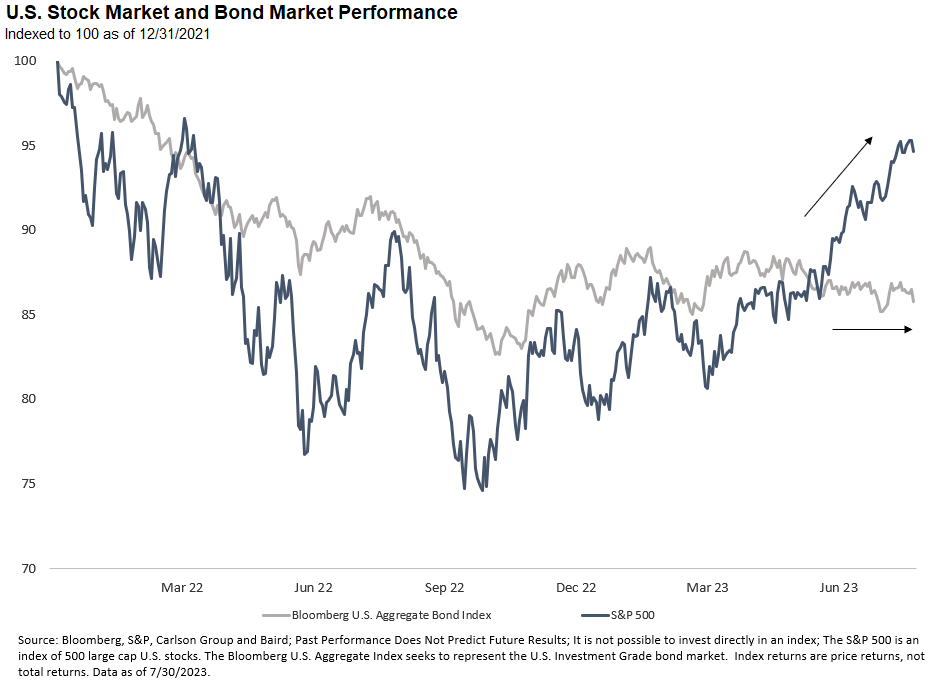
Last year, both stocks and bonds fell. This created an opportunity in both asset classes. This year, the stock market has rebounded while bond prices have mostly moved sideways (chart below).
The result?
The near-term return potential for stocks has fallen somewhat. Bonds, however, still offer promising post-sell off opportunities.
Thus, the return potential between stocks and bonds has likely narrowed a bit. If your allocation to stocks is near the high end of your strategic range, now may be a good time to rebalance by trimming stocks and buying fixed-income.
That being said, if your portfolio is overweight equities, it's important to understand why. If it is merely because bonds declined in 2022, rebalancing may be less beneficial. On the other hand, if you capitalized on the 2022 sell-off by buying stocks and are now overexposed, the argument for rebalancing is more compelling.
RAQ: Did the 2022 inverted yield curve falsely predict a recession?
The inverted yield curve, where short-term interest rates exceed long-term rates, is a closely followed economic indicator on Wall Street. It often precedes a recession, perhaps because it signals that the Federal Reserve has raised rates by more than the economy can handle. Here’s a look at its track record:
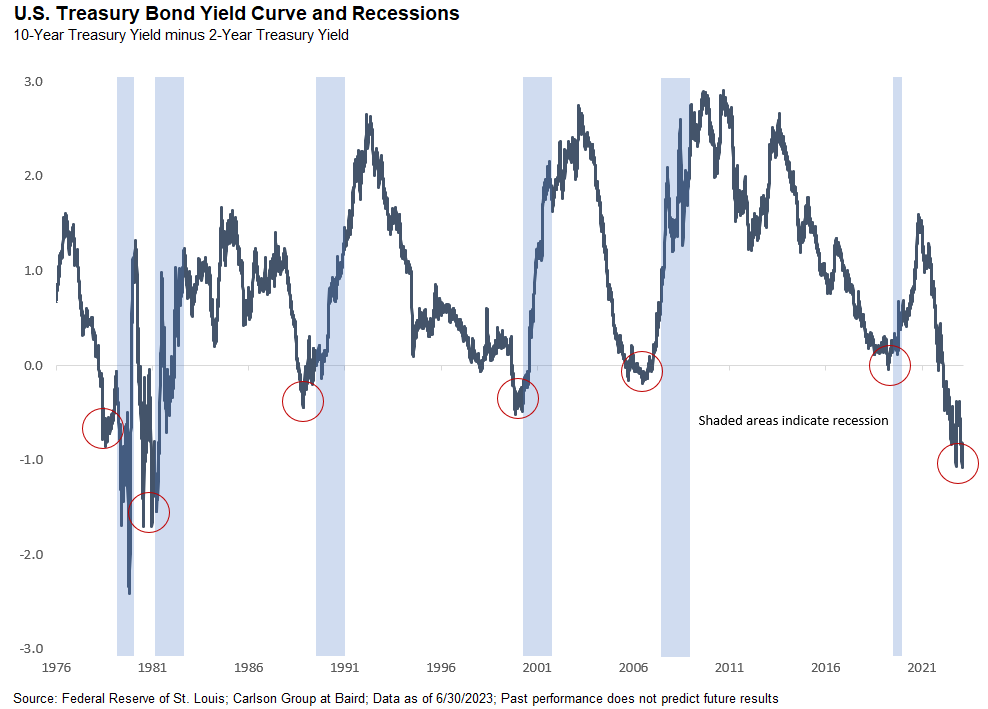
April 2022 saw an inverted curve. Sixteen months later, there is still no recession.
So, was it a false alarm?
We can't say for certain because we don’t know if a recession is lurking around the corner.
However, it’s evident that many investors misinterpreted the inverted curve's message.
Think of an inverted curve as an early warning signal and not necessarily a sign of impending danger. It's like the first cool evening in late summer: it hints at the change of seasons, but a freeze is not necessarily imminent. Similarly, the stock market often continues to rise after the yield curve inverts and before a recession arrives.
Interestingly, in our experience over the past 12 months, many individual investors have been more optimistic on the stock market than many on Wall Street. Why? Perhaps because individuals tend to gauge the economy through their experiences – booked flights, busy malls, etc. In contrast, Wall Street often relies on abstract indicators like the yield curve, which – though useful – are a poor substitute for direct experience.
Thanks for reading! Have a question you'd like to have answered? Drop us a line at carlsongroup@rwbaird.com.